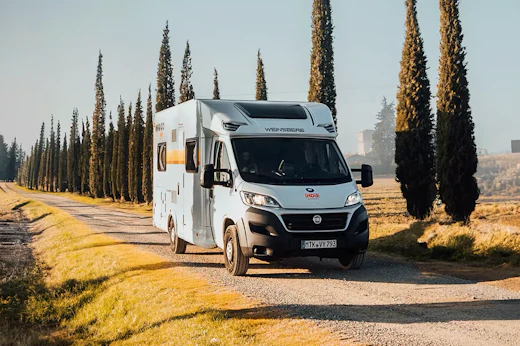
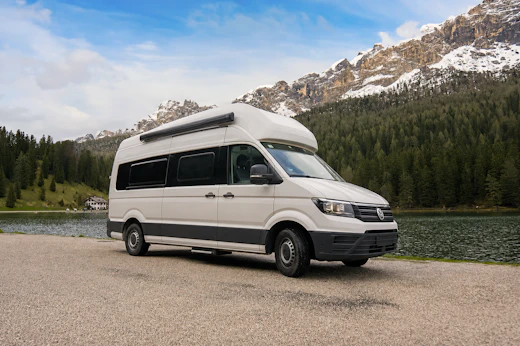
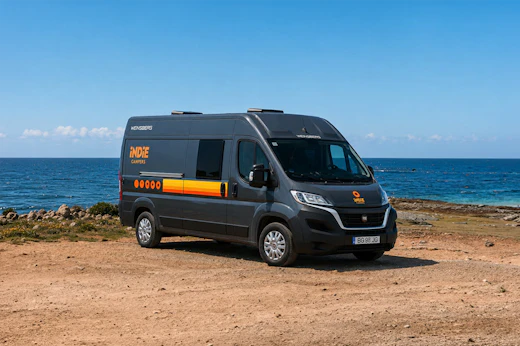
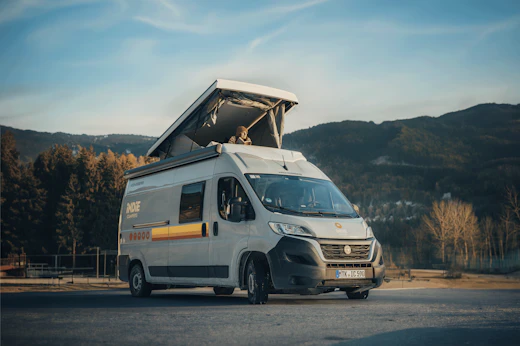
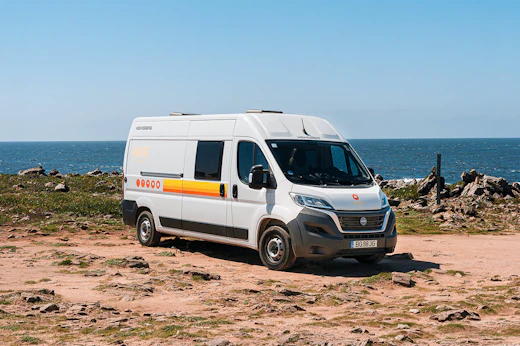
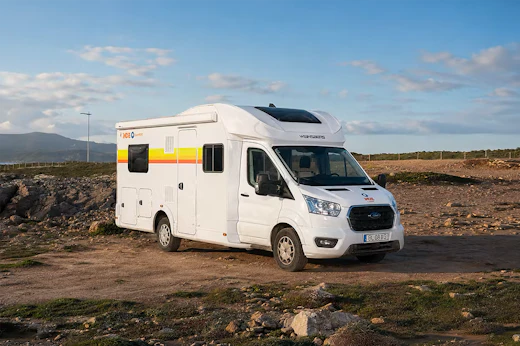
Start your northern adventure with an RV hire from Hamburg and discover Germany's coastal charm or venture towards Scandinavia. Explore the breezy shores of the Baltic Sea, take a cultural detour to Berlin, or journey north through Denmark's rolling countryside. Choose the campervan that matches your travel style from Indie Campers' versatile fleet, all with unlimited kilometres, flexible one-way options, and thoughtful extras like bedding kits, towel kits, or child seats to make your trip more comfortable. With thousands of five-star reviews and a trusted Europe-wide fleet, Indie Campers makes it easy to explore northern Europe with freedom and ease.


Our Road Trips Itineraries
Hamburg's routing advantage comes from its position at the junction of three entirely different geographic zones: the North Sea coast to the northwest, the Baltic coast to the northeast, and the Central European lowland corridor to the south and east. A single location covers three coastlines, two UNESCO World Heritage landscapes, and four national parks within a 3-hour radius. No other northern German city sits at that confluence.
The itinerary that works only by RV from Hamburg is the Coastal Arc: north on the A7 and B5 to Sylt (160 kilometres, 2 hours), east along the Schleswig-Holstein coast road through Husum and Flensburg, across the Danish border into South Jutland, and down the Danish west coast through Esbjerg and the Wadden Sea National Park of Denmark before returning south to Hamburg. The loop covers approximately 900 kilometres and connects German, Danish, and Dutch Wadden Sea landscapes in a single continuous route. Hotel-based travellers on this circuit would need 6-7 bookings in small coastal towns, some of which have limited accommodation inventory in peak season. The RV version needs three campsites and a Stellplatz, all of which sit directly on the coast.
The specific thing Hamburg offers that no other German depot replicates is the Elbe River corridor itself. From Hamburg, following the Elbe southeast on the B5 and B195 through the Elbe-Elster lowlands takes you through a landscape that was the inner German border for 40 years and is now the Grünes Band (Green Belt) nature corridor. Driving this route from Hamburg to Dresden puts you on one of the few roads in Europe where the landscape itself is a direct record of 20th-century political history, visible in the strip of unmanaged grassland, scrub, and forest that runs the entire 1,393-kilometre former border.
Here is what separates Indie Campers from other Hamburg hire options:
Unlimited mileage: Drive from Hamburg north to Sylt, east to Rügen, south to the Lüneburg Heath, and west through the North Sea marshes without watching a daily kilometre counter. Most Hamburg competitors cap at 200-250 km/day.
One-way hires across 100+ locations: Pick up in Hamburg, drop off in Copenhagen, Berlin, Amsterdam, Frankfurt, or Munich. The Hamburg-to-Copenhagen one-way via the E45/A7 through South Jutland (380 kilometres, 4 hours 30 minutes) is one of the most historically significant short cross-border routes in the network.
24/7 road assistance: Included on every booking. If something fails on the dike road between Büsum and Friedrichskoog or on the B96 approaching Stralsund at 11:00 p.m., there is a number to call. Germany's ADAC service covers the full country.
Basic Protection Plan included: Covered from day one. Additional protection upgrades are available at booking.
Flexible cancellation available: Cancel up to 31 days before pick-up without penalty.
Book now, pay later: Reserve your Hamburg vehicle today; full payment is not required until closer to the departure date.
Spring (March to May)
Temperatures: 5-17°C (41-63°F)
The North Sea coast wakes up slowly in spring. Lambing season on the Schleswig-Holstein dike grasslands runs March through April, with Heidschnucke sheep lambs on the Lüneburg Heath from late March. The Wadden Sea spring bird migration peaks April through May, when Arctic waders, bar-tailed godwits, and knots move through the mudflats in concentrations of tens of thousands. The heather on the Lüneburg Heath has not bloomed yet, but the birch and juniper show their first growth. Campsite availability across the North Sea coast and the lake district is good; book 3-4 weeks ahead for Easter weekend in Schleswig-Holstein, which fills early.
Best for: Wadden Sea spring migration, Elbe River flooding meadows (the Elbe between Hamburg and Lauenburg floods its floodplain in March and April, producing a temporary wetland visible from the B209 that empties as spring progresses), and Sylt before the summer crowd.
Skip if: You want to swim anywhere. North Sea water temperatures in March through May run 5-10°C; Baltic temperatures are similar.
Summer (June to August)
Temperatures: 15-24°C (59-75°F)
Hamburg's summer is moderate by Central European standards. Temperatures rarely exceed 28°C for extended periods, and the proximity to the North Sea keeps humidity manageable compared to Berlin or Frankfurt. The North Sea coast summer draws large numbers from Hamburg and the Rhine-Ruhr area; Sylt, St. Peter-Ording, and Timmendorfer Strand all fill on summer weekends, and campsite prices on the coast run 40-60% above shoulder-season rates. The Baltic coast on Rügen and Usedom is at full swimming capacity in July and August, with sea temperatures reaching 18-22°C. The Lüneburg Heath heather bloom has not yet begun; the heath is green and quiet.
Best for: Baltic swimming on Rügen, North Sea beach walking at St. Peter-Ording (the broadest beach in Germany at 12 kilometres wide), and Holsteinische Schweiz lake paddling.
Skip if: You want uncrowded North Sea coastal campsites on summer weekends. Sylt and St. Peter-Ording fill by Thursday night in July and August, and weekend walk-in availability on the coast is essentially zero.
Autumn (September to October)
Temperatures: 7-16°C (45-61°F)
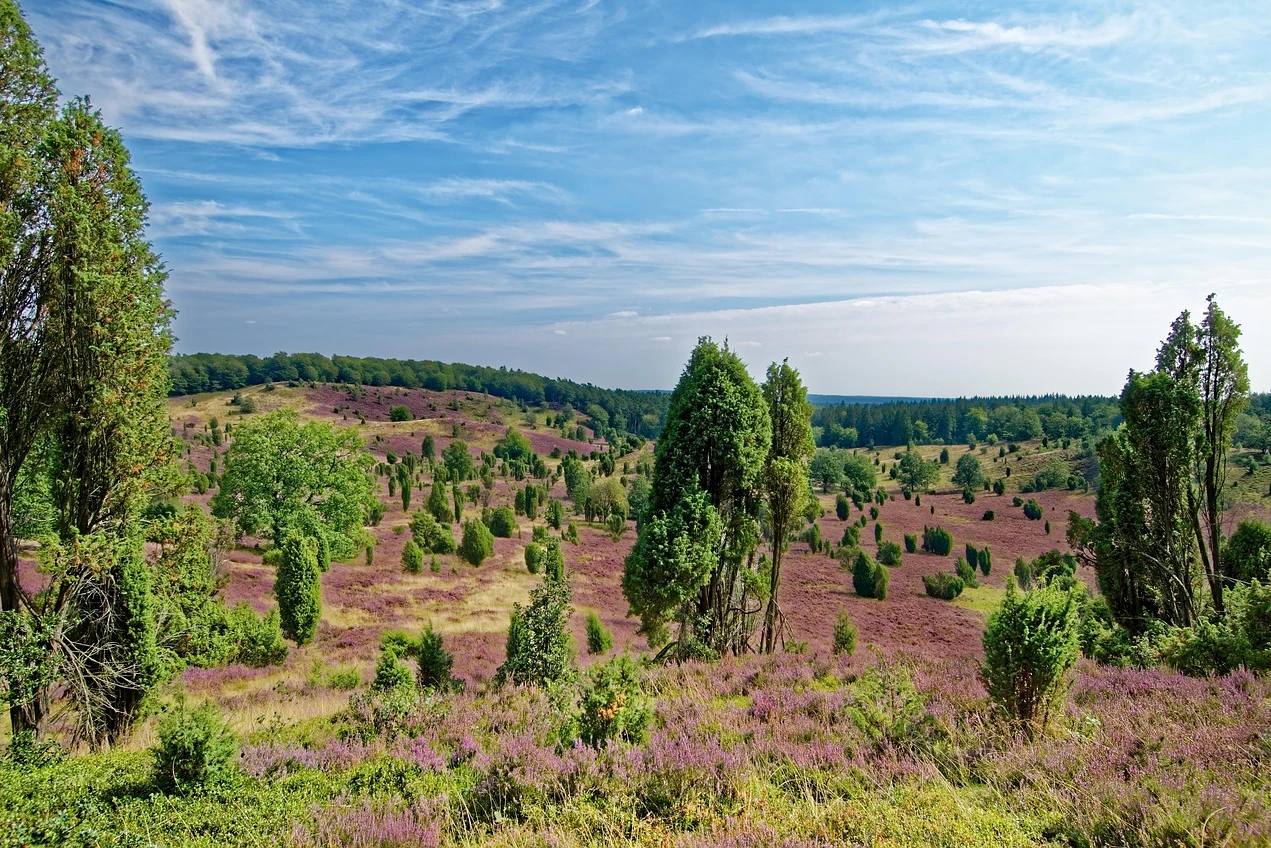
The Lüneburg Heath heather bloom peaks mid-August through mid-September, a 3-4 week window when the plateau turns reddish-purple and the specific combination of heather, juniper, and sand creates a landscape with no visual equivalent anywhere else in northern Germany. The Heidschnucke sheep are moved through the heath in traditional flocks during September, the last working example of transhumance in the North German lowlands. Coastal campsites drop to 40-50% of summer occupancy after the first week of September, and the North Sea light in September and October is the best of the year for photography: low angle, long golden hours, and frequent dramatic cloud formations above the flat tidal landscape.
Best for: Heather bloom (book the week of August 20 to September 10 specifically if this is the target), autumn storm walking on the North Sea coast, Rügen beech forest colour in mid-October.
Skip if: You need reliable swimming temperatures. North Sea and Baltic water cools to 12-14°C in September, which is viable for wetsuits but not comfortable open swimming.
Winter (November to February)
Temperatures: -1 to 6°C (30-43°F)
Hamburg's Christmas markets run from late November through December 23rd. The Rathausmarkt market (GPS: 53.5505° N, 9.9935° E) directly in front of the city hall is the largest; the Historischer Weihnachtsmarkt Rathausmarkt opens with around 200 stalls. The North Sea coast in winter delivers a specific kind of experience: storm surges visible from the dike roads, the flat grey light of the Wattenmeer at low tide, and essentially no other travellers. A small number of coast and heath campsites stay open year-round. Many Schleswig-Holstein sites close October through March; verify before routing.
Best for: Hamburg Christmas markets, winter storm coast walking, city time with easier access to Elbphilharmonie concerts (the main season runs September through June with good availability outside peak periods).
Skip if: You are planning extended outdoor activity in exposed coastal or heath terrain. Wind chill on the North Sea coast in January and February makes standard winter clothing inadequate; specialist windproof layers are essential.
The most popular months for Hamburg campervan hires are June, July, August, and September.
3 to 5 Days
North Sea and Heath Circuit (approx. 420 km, 4 days)
Lübeck and Baltic Express (approx. 350 km, 3 days)
Schleswig-Holstein Coastal Arc (approx. 850 km, 8 days)
Hamburg to Copenhagen, One-Way (approx. 1,400 km, 14 days)
Note: Denmark has no motorway vignette requirement for campervans. The Øresund Bridge between Copenhagen and Malmö, Sweden costs DKK 385 (approximately €52) per vehicle one-way if extending the route into Scandinavia.
Fuel Stations
Hamburg Autobahn Rasthöfe (motorway service stations) price fuel 10-15 cents per litre above city-level pump prices. Fill at a city petrol station or supermarket forecourt before taking any motorway leg.
Average fuel price in Germany (2025 estimate): €1.75-1.90/litre diesel; €1.80-1.95/litre petrol.
LPG/Propane Refill
Hamburg has several LPG points. Coverage thins on Sylt (one LPG station on the island; verify before routing) and is absent on Fehmarn island; fill on the mainland before taking either island crossing.
Dump Stations (Entsorgungsstationen)
Essential Apps
Age and Licence Requirements
Minimum hire age: 21 years.
EU licence holders: A full EU driving licence is valid in Germany and Denmark without additional documentation. It is also valid in Sweden and the Netherlands if extending the route north or west.
International visitors (non-EU): An International Driving Permit (IDP) is recommended alongside your national licence for Germany and strongly advised for Denmark. Obtain your IDP before departure; it is not available at German airports or hire counters.
Credit Card and Deposit
A credit card in the primary driver's name is required at pickup. The security deposit is held on the credit card at pickup; the amount varies by vehicle class and protection plan selected.
North Sea and Baltic Weather Preparation
Indie Campers provides all vehicles with standard safety equipment. For North Sea coastal routing specifically, the wind-related risks to awnings and external equipment are not covered by standard protection; secure all external additions (chairs, tables, bike racks) before parking at exposed coastal Stellplätze.
Reservation Systems
Speed Limits
Hamburg operates automated speed enforcement on several arterial roads; mobile radar units are used throughout the city without advance notice.
Road Conditions
Driving Culture
The Autobahn left-lane rule applies throughout: right lane always when not overtaking; left lane only when actively passing. Return to the right lane immediately after. This is law, not convention, under §7 StVO.
Hamburg city intersections with traffic lights: a flashing yellow amber phase precedes the red; this means slow and prepare to stop, not accelerate. Drivers from countries without this phase sometimes misread it.
Cyclists in Hamburg have legal priority in marked cycle lanes; the city has an extensive network of protected cycle infrastructure, and campervans turning at intersections must check cycle lanes before completing any turn. The inner-city cycling lane network around the Alster and HafenCity is among the most developed in Germany.
RV-Specific Notes
Height: Hamburg city-centre car parks clear 2.0-2.4 metres. Park at Stellplätze on the city fringe (Altona, Schnelsen, Wandsbek areas) and use the HVV public transport network for city access. Most fringe Stellplätze are within 30 minutes of the Rathaus by U-Bahn or S-Bahn.
Length: The Sylt Shuttle car-train has a maximum vehicle length of 9 metres; the dike road Stellplätze in Dithmarschen have practical length limits of 7-8 metres on the narrower approach tracks.
Elbtunnel and LPG: If your vehicle's propane system is sealed (no open flame access while driving), most German tunnels permit entry; if in doubt, use the Köhlbrandbrücke alternative route across the Elbe.
North Sea wind: Awning poles on standard RV awnings are not designed for sustained 60+ km/h wind loads. Retract the awning and secure all exterior attachments before leaving the vehicle at any exposed North Sea coastal Stellplatz.
Wildlife: The B404 and A1 corridors in Schleswig-Holstein have active red deer and wild boar crossings from dusk to dawn, particularly in the forested sections between Lübeck and Kiel. Reduce speed on unlit rural roads after dark. On the Lüneburg Heath, Heidschnucke sheep graze on unfenced common land adjacent to the B3 and B209; treat the road edges as livestock zones throughout.
Legal Notes
BAC limit: 0.05% for licensed drivers; 0.00% for drivers under 21 or within two years of receiving a licence. Random breath testing is conducted in Germany without requiring cause or reasonable suspicion.
In Denmark (if crossing): BAC limit is 0.05%. Danish traffic police conduct frequent breath-testing operations at the German-Danish border crossing and on E45 northbound.
RV hire: €700-1,800 (varies by vehicle size and season; North Sea coast summer weeks from late June through August add 20-35% above shoulder-season rates; book 2-3 months ahead for July and August)
Fuel: €140-280 (diesel approximately €1.85/L; typical weekly distance 600-900 km on a North Sea coast circuit divided by 10L/100km = 60-90 litres; Sylt and Danish route legs run more expensive on fuel due to above-average pump prices on the island and in Denmark)
LPG/Propane: €10-30 (if a mid-trip refill is needed; fill in Hamburg before departure and at the last mainland station before Sylt)
Tolls: €0-80 (€0 on all German Autobahn; Sylt Shuttle car-train approximately €55-80 per campervan one-way depending on vehicle length and season; Denmark no motorway tolls; Øresund Bridge €52 if routing to Copenhagen; Fehmarn bridge)
Campgrounds: €105-350 (€15-50/night x 7; Stellplätze via Park4Night at the low end €5-15/night; North Sea coast lakeside and beach sites at the high end; Sylt campsite premium applies in July and August)
Food: €180-450 (self-catering from Kaufland and Edeka approximately €35/day; mixed cooking and dining including Fischmarkt Sunday morning and one Bullerei or Zum Alten Lotsenhaus evening approximately €65/day; regular restaurant meals €90+/day)
Activities: €40-160 (Miniatur Wunderland €20; Elbphilharmonie Plaza free; Holstentor Lübeck €10; Wadden Sea guided walk approximately €14/adult; Königsstuhl Jasmund €8; Wilseder Berg free; Rotes Kliff Sylt free)
Parking: €0-35 (Stellplätze €5-15/night on dike road; Hamburg city centre RV parking not practical; P+R at fringe S-Bahn and U-Bahn stations €2-5/day)
Budget: approx. €1,000 -- Compact vehicle, all self-catering from Kaufland, Stellplätze and lower-cost heath and Elbe riverside campsites, German-only routing with no Sylt Shuttle, free attractions throughout (Speicherstadt walk, Elbphilharmonie Plaza, dike road drive, Lüneburg Heath walks, Fischmarkt).
Mid-range: approx. €1,850 -- Mid-size vehicle, mix of self-catering and two restaurant evenings (Fischmarkt Sunday morning, one sit-down dinner in Hamburg or Lübeck), North Sea coast campgrounds with hookups, Sylt Shuttle included, Miniatur Wunderland, guided Wadden Sea walk.
Premium: approx. €3,000+ -- Larger motorhome, frequent dining including Zum Alten Lotsenhaus and Bullerei, full-hookup Sylt campsite, Denmark extension including Ribe and Fanø island, Copenhagen one-way drop-off, Jasmund cliff visit, all attraction entries, Stena Line Baltic ferry extension to Sweden included.
Hamburg routes average lower total costs than Munich or Zurich routes: no Alpine toll roads, no Swiss vignette, and Lower Saxony and Schleswig-Holstein campsites price below their Bavarian equivalents. The cost rises when crossing to Sylt (Shuttle train fee plus island campsite premium) or into Denmark and Scandinavia, where campsite prices run 40-60% above German equivalents. The most cost-effective Hamburg routing stays entirely within Germany: Lüneburg Heath, Lübeck, and the North Sea coastal road deliver the full geographic range of the region at consistently lower cost than the Sylt or Copenhagen extensions.
Hamburg → Copenhagen (380 km, 4 hours 30 minutes via A7/E45): The primary Hamburg one-way. The E45 crosses the Danish border at Kruså/Padborg and continues north through South Jutland to Copenhagen. Denmark has no motorway vignette. The route via Ribe and Esbjerg on the west coast (530 km, 6 hours 30 minutes) adds the Wadden Sea and Fanø island as natural stops. Drop off at the Indie Campers Copenhagen.
Hamburg → Berlin (280 km, 2 hours 30 minutes via A24): The main east-west corridor. The A24 passes through the Mecklenburg lake district; the B5 detour through Ludwigslust adds 20 minutes and passes through the former inner German border zone. Drop off at the Indie Campers Berlin.
Hamburg → Amsterdam (620 km, 6 hours via A1): Southwest through Bremen, Osnabrück, and the Netherlands border at Nordhorn. Dutch motorways carry no vignette for campervans. Drop off at the Indie Campers Amsterdam.
Hamburg → Munich (780 km, 7 hours via A7): South through Hanover, Kassel, Würzburg, and Augsburg into Munich. The A7 is Germany's longest Autobahn at 963 kilometres, and the Hamburg-to-Munich leg covers most of it. Natural stops: Hannover (195 km, 2 hours), Göttingen (300 km, 3 hours), Würzburg (500 km, 5 hours). Drop off at the Indie Campers Munich depot.
Hamburg → Frankfurt (500 km, 4 hours 30 minutes via A7): Via Kassel and the A5. Natural stop at Kassel for the Bergpark Wilhelmshöhe (UNESCO World Heritage, GPS: 51.3166° N, 9.3756° E, park free, Hercules monument €5 adults).
Hamburg → Stockholm (1,000 km, 10 hours via E45 and Øresund Bridge): The Scandinavian long-haul one-way. Copenhagen is the natural halfway stop. The Øresund Bridge (DKK 385 / approximately €52 one-way) connects Denmark to Sweden at Malmö. Drop off at the Indie Campers Stockholm.
One-way fees vary by route and season. Confirm availability and pricing at the time of booking.
Hamburg is the only German depot in the Indie Campers network where you pick up the vehicle and can be on a North Sea tidal flat, watching the tide recede across 2,900 square kilometres of exposed mudflat, in under 90 minutes. That specific landscape, and the specific kind of scale it delivers, is what makes Hamburg different from every other northern European pickup point. The Wadden Sea is the largest intertidal ecosystem on earth. It does not look impressive from above on a map. It looks impressive when you are standing in the middle of it with the nearest road 4 kilometres behind you and the tide has retreated to a point where you can see Denmark 15 kilometres across the water.
What is singular to a Hamburg start, and not replicable from any other depot in the network, is the Hanseatic corridor. The Hanseatic League was a commercial and defensive network of trading cities across Northern Europe that operated from the 13th to the 17th centuries and left behind the most concentrated belt of brick Gothic architecture in the world. Hamburg and Lübeck were its two most powerful members. Drive north from Hamburg through Lübeck (60 km), across to Wismar (140 km), and east to Stralsund (290 km), and every major town on that route is a Hanseatic city with UNESCO-listed architecture on a scale and in a condition that is directly explained by what the Hanse built here between 1300 and 1600. This is a 290-kilometre corridor of coherent history visible from the road, and it starts directly outside the Hamburg depot.
The morning of pickup, be at the Fischmarkt at 5:30 a.m. (Fischmarktplatz 1, Sunday only; or the Isemarkt on Wednesday and Saturday morning at Isestraße for weekday departures). Buy Räuchermakrele (smoked mackerel), rye bread, and the season's first fruit from whichever stall has the best display. Walk 15 minutes along the Elbe to the Elbphilharmonie Plaza and watch the container port wake up from 37 metres above the river. Then collect the vehicle and take the A23 northwest. The Wadden Sea low-tide walk at Büsum starts at whatever time the tides dictate that day; plan backward from the tide schedule, not forward from your morning ambitions.
For most travelers, a special licence is not necessary to hire a campervan in Hamburg. A valid driving licence is required, though, to operate any of our vehicles. If you are a non-EU citizen, an International Driving Permit (IDP) may be required in addition to your home country’s driving licence. Additionally, your licence must match the transmission type of the vehicle (manual or automatic). You can find more details about driving licence requirements here.
Yes, our campervans are pet-friendly
Our Road Trips Itineraries
The sleeping capacity of our campervans and motorhomes varies depending on the model and size. Our Class C motorhomes can typically accommodate 4 to 8 people, while our Class B campervans can sleep between 2 to 4 people. Vehicles equipped with a rooftop tent generally have space for around 2 people. For a full breakdown of our models and sleeping capacities, click here.
If you're exploring Hamburg in a campervan rental, it's essential to be aware of the country’s official camping regulations. Many natural areas are legally protected, so using designated overnight parking spots or official campsites is strongly recommended. This not only helps preserve the environment but also ensures a safe and enjoyable experience. For more guidance on safety and responsible camping, click here.
We provide three different protection plans to cover any incidents or damages that might occur during your campervan rental. All Indie Campers campervans come with third-party vehicle insurance, and property damage coverage (which varies based on the country). For marketplace rentals, insurance options may differ depending on the host. For further details on campervan insurance, visit this page.
Yes, our search filter makes it easy to rent a campervan close to your location by using a 60km radius system. Depending on where you're searching from, you can quickly find the nearest Indie Campers campervan rental pick-up centre.
Yes, a selected number of Indie Campers RV rentals in Hamburg include unlimited mileage, allowing you to explore freely and make the most of your road trip! Please note that unlimited mileage applies exclusively to Indie Campers RVs and is subject to responsible use.
“Es war eine wunderbare Erfahrung und alles hat geklappt! David beim Pickup und Sarah beim abgeben waren super lieb und hilfsbereit! Der Camper war auch toll und es hat alles geklappt 👍”
“We needed a camper van with less than 1 days notice and Sara at the office in Hamburg was amazing. She went over and above to ensure we had a vehicle to use for our holiday - thank you so much Sara ⭐️⭐️⭐️⭐️⭐️”
“It was a good experience and the staf Sara and David are so Nice and helpfull”
Our Campervans