Start your campervan journey from an RV hire in Berlin and explore lakes, castles, and neighbouring countries on your own schedule. Visit the forests and waterways of Brandenburg, discover the cultural treasures of Saxony, or drive east toward Poland and the Czech Republic. Choose the campervan that suits your trip best, from our California, Active, or Comfort models, all with unlimited kilometres, flexible one-way travel, and helpful extras like outdoor furniture, child seats, or bedding and towel kits to make every part of your journey more comfortable. Indie Campers is trusted by thousands, backed by a Europe-wide fleet and 4.8-star rated service.

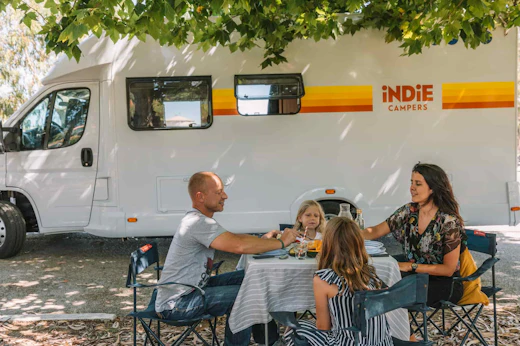

Our Road Trips Itineraries
Berlin's geography creates a routing advantage that works differently from any other city in the network. The flat terrain means no alpine pass closures, no weight restrictions on switchback roads, and no seasonal closures. Autobahn coverage radiates from the city in every direction with four-lane infrastructure as far as the Polish border in the east and the Danish border in the north. The result is a depot where a realistic three-day itinerary places you in three different countries without a single extreme driving day.
The route that makes the clearest case for an RV from Berlin is the Mecklenburg Lakeland Circuit: north via the A24 to Müritz (130 km), west along the B198 through Waren and Röbel to Schweriner See (145 km), then south through Ludwigslust back toward Hamburg or Berlin (160-230 km depending on endpoint). The loop covers Germany's most extensive lake district, with campsite pitches positioned directly on the water throughout. A hotel-based version of this route needs four separate reservations in towns that do not all have meaningful hotel inventory. The RV version needs three lakeside pitches booked through Camping.info or Park4Night.
Here is what sets Indie Campers apart from other Germany hire companies:
Unlimited mileage — Drive from Hamburg to Berchtesgaden (800 km), along the full Romantic Road (460 km), and back without a per-day distance calculation. Most competitors in Germany cap at 200-250 km/day; exceeding that on a typical German circuit generates significant overage charges.
6 pickup locations across Germany — Start in Frankfurt and end in Munich. Pick up in Düsseldorf-Essen and drop off in Stuttgart. Or begin in Berlin and finish in Hamburg. No backtracking to your start city and no return flight from the wrong end of the country.
One-way hires across 100+ locations globally — Cross from Germany into France, Austria, the Netherlands, or Denmark, on a single booking. The central European network connects German cities to Amsterdam, Paris, Vienna, and Copenhagen.
24/7 road assistance — Included on every booking, regardless of which federal state you are in when something goes wrong.
Basic Protection Plan included — Covered from day one. Upgrade options available at booking.
Flexible cancellation available — Cancel up to 31 days before pickup without penalty.
Spring (March to May)
Temperatures: 4-18°C (39-64°F)
The Spreewald waterways open for paddling from April when the alder channels run at their fullest and birdlife is at peak activity. The crane migration through the Müritz corridor peaks on its northbound return leg in late March and early April. Brandenburg's beech forests are at their most atmospheric in late April when new leaves open a translucent spring green before darkening into summer canopy. Campsite availability is good across the region; book 3-4 weeks ahead for Easter weekend.
Best for: Wildlife watching targeting the crane migration; paddlers wanting the Spreewald at full water levels; Baltic cliff walks before the summer crowds arrive on Rügen.
Skip if: You want to swim in the Baltic or inland lakes. Water temperatures in March and April stay below 10°C across the region.
Summer (June to August)
Temperatures: 18-28°C (64-82°F)
Berlin's warmest months coincide with the Baltic coast's only reliable swimming window. Sea surface temperatures at Rügen and Usedom reach 18-22°C in July and August. The Müritz is swimmable from June through September. Campgrounds throughout Brandenburg and Mecklenburg fill on summer weekends, particularly lakeside sites within 150 km of Berlin. The Berlin techno and music festival season runs through summer; city-fringe Stellplätze on event weekends can fill, but rural campsite availability is unaffected.
Best for: Baltic swimming, lake paddling, all national park trails at full accessibility, families with school-age children.
Skip if: You want uncrowded lakeside campsites on summer weekends within 150 km of Berlin. Those fill by Thursday night from late June through August.
Autumn (September to October)
Temperatures: 8-18°C (46-64°F)
The crane migration through the Müritz peaks in October and November, with an estimated 50,000-60,000 birds using the lake as a staging roost. Beech forest colour in Saxon Switzerland and at Jasmund peaks in mid-October. The Berlin Marathon takes place on the last Sunday of September (approximately 45,000 registered runners, significant road closures in the city centre on race day). Campsites drop to 30-40% of summer occupancy from mid-September, and many lakeside sites offer their best walk-in availability of the year.
Best for: Wildlife photography, autumn forest walking, Müritz crane watching, Saxon Switzerland hiking with dramatically reduced visitor numbers.
Skip if: You need reliable warm temperatures for lake swimming. Baltic and inland lake water drops below comfortable swimming levels after mid-September.
Winter (November to February)
Temperatures: -3 to 5°C (27-41°F)
Brandenburg's Christmas markets run from late November through December 23rd. The Berliner Weihnachtsmarkt at the Gendarmenmarkt is one of the most respected markets in Germany; entry costs €1 in the evenings. A small number of campgrounds stay open for winter visitors near Berlin and in major towns. Many rural Mecklenburg sites close from October 31st through March; verify availability before routing. Road surfaces in Brandenburg and Mecklenburg can include ice and hard frost from December through February.
Best for: Christmas market touring through Berlin and small Brandenburg towns; city time with easier access to Reichstag and Museum Island bookings outside peak season.
Skip if: You are planning any extended outdoor activity or overnight stays in unheated conditions. Winter temperatures in the Berlin region make that approach impractical.
The most popular months for Berlin campervan hires are June, July, and August.
3 to 5 Days
Brandenburg Lakes and Capital Circuit (approx. 320 km, 4 days)
Baltic Express (approx. 500 km, 5 days)
7 to 10 Days
Eastern Europe Overland: Berlin to Kraków (approx. 900 km, 9 days, one-way)
14 Days or More
The Baltic and North Sea Arc: Berlin to Copenhagen, One-Way (approx. 1,600 km, 14 days)
Fuel Stations
German motorways carry no tolls for campervans under 7.5 tonnes, but Autobahn Raststätten fuel consistently runs 10-15 cents per litre above off-motorway prices. Fill at a supermarket forecourt before leaving Berlin rather than at the first motorway stop.
Average fuel price in Germany (2025 estimate): €1.75-1.90/litre diesel; €1.80-1.95/litre petrol/E10.
LPG/Propane Refill
The Berlin metro area has solid LPG coverage. Coverage thins on smaller roads through the Mecklenburg interior and on Rügen island; fill before entering either.
Age and Licence Requirements
Minimum hire age: 21 years.
EU licence holders: A full EU driving licence is valid in Germany, Poland, the Czech Republic, and Denmark without additional documentation.
International visitors (non-EU): An International Driving Permit (IDP) is recommended alongside your national licence for Germany and is required or strongly advised for Poland and the Czech Republic. Obtain your IDP from your home country's automobile association before departure; it is not available at German airports or hire counters.
Credit Card and Deposit
A credit card in the primary driver's name is required at pickup. Debit cards and prepaid cards are not accepted. The security deposit is held on the credit card at pickup; the amount varies by vehicle class and selected protection plan. Confirm the exact deposit during booking.
National Park Passes
Germany has no unified national park pass. Entry to Müritz National Park, Jasmund National Park, and the Spreewald is free. Saxon Switzerland's Königsstuhl Visitor Centre charges €8 adults for the platform; the wider park is freely accessible. Czech and Polish national parks each have their own entry systems; check individually for parks on your route.
Reservation Systems
There is no single German campsite booking platform equivalent to Recreation.gov. Use Camping.info, the ADAC Camping portal, or direct campsite websites.
Speed Limits
Speed cameras: Fixed positions are legally published in German navigation apps. Mobile radar traps are not pre-announced. Automated school zone enforcement operates in parts of Berlin.
Road Conditions
Driving Culture
The Autobahn left-lane rule is not discretionary: staying in the left lane while not actively overtaking is illegal under §7 StVO. Right lane always; left lane only during overtaking; return to right immediately after. Flashing from behind is the standard signal that you are in the wrong lane.
Roundabouts: Traffic inside has right of way. Yield on entry.
In Berlin's city streets: pedestrian crossings are legally mandatory stops the moment a pedestrian steps onto the crossing. Cyclists in designated lanes have formal right-of-way; crossing a cycle lane without checking first is a common error for drivers from countries with less developed cycling infrastructure.
RV-Specific Notes
Height: Input your vehicle's roof height into navigation before entering Berlin or any Brandenburg town. City centre car parks have clearances of 2.0-2.4 m; none are accessible by campervans.
Length: Mecklenburg campsites generally accommodate up to 8 metres. Check individual approach roads for Spreewald pitches and Rügen sites where access tracks can narrow on the final approach.
Propane/LPG: No restrictions in standard German road tunnels. For Eastern European tunnels, check specific restrictions before routing; some Czech and Polish tunnels restrict unsealed gas cylinders.
Parking: Berlin city centre metered parking runs €3-4/hour with strict 2-hour limits on weekdays. For city-day access, park at a Stellplatz on the city fringe (Köpenick, Spandau, or Reinickendorf areas) and use the S-Bahn or U-Bahn. Most fringe Stellplätze are within 30 minutes of Alexanderplatz by public transport.
Wildlife: Wild boar crossings are active on forest roads throughout Brandenburg at dawn and dusk year-round. Deer crossings are common on the B24 north of the city and throughout the Mecklenburg interior. Reduce speed to 80 km/h on unlit rural roads after dark.
Legal Notes
BAC limit: 0.05% for licensed drivers; 0.03% for drivers under 21 or within two years of receiving a licence. Random breath testing is conducted in Germany without requiring cause.
First-offence DUI: from €500 at readings above 0.05%; licence suspension from 0.05-0.159%; criminal prosecution from 0.16% and above.
RV hire: €700-1,800 (varies by vehicle size and season; Berlin festival weekends and the Berlin Marathon week in late September can add 15-25% to peak rates; book 2-3 months ahead for July and August)
Fuel: €140-300 (diesel approx. €1.85/L; typical weekly distance 600-800 km ÷ 10L/100km = 60-80 litres; Eastern European routes reduce fuel costs once across the Polish or Czech border, where prices run €0.10-0.20/L cheaper)
LPG/Propane: €15-40 (if a mid-trip refill is needed; Berlin metro area has good LPG coverage; fill before entering the Müritz interior or heading onto Rügen, where availability between towns is unreliable)
Tolls: €0-60 (€0 on all German Autobahn; add approximately €16 for Czech 10-day digital vignette; Polish e-TOLL per-km charges on expressways; DKK 385 / approximately €52 for the Øresund Bridge if routing to Copenhagen)
Campgrounds: €105-350 (€15-50/night × 7; Stellplätze via Park4Night at the low end at €5-15/night; lakeside sites on the Müritz or Baltic coast at the high end)
Food: €180-480 (self-catering from Kaufland or ALDI approx. €35/day; mixed cooking and dining including Curry 36 and one Markthalle Neun evening approx. €60/day; regular restaurant meals run €90+/day)
Activities: €30-200 (Museum Island combined ticket €29; Königsstuhl/Jasmund entry €8; Neues Museum €14; Tempelhof Field, East Side Gallery, and Topography of Terror all free; Reichstag dome free with advance registration)
Parking: €0-40 (Stellplätze €5-15/night; city centre RV parking not practical; P+R at outer S-Bahn stations €2-5/day)
Budget: approx. €1,100 — Compact vehicle, all self-catering from ALDI and Kaufland, Stellplätze and lower-cost Brandenburg campsites, German-only routing with no border crossings, free attractions throughout (East Side Gallery, Tempelhof, Topography of Terror, Reichstag with advance booking, Müritz wildlife walks with no entry fee).
Mid-range: approx. €1,900 — Mid-size vehicle, mix of self-catering and eating out (Curry 36, Markthalle Neun, one sit-down restaurant meal), lakeside campgrounds on Müritz or Baltic coast with hookups, Czech crossing with digital vignette, Museum Island day ticket, Königsstuhl entry.
Premium: approx. €3,200+ — Larger motorhome, frequent dining including the Käfer Dachgarten at the Reichstag and a proper Dresden restaurant evening, full-hookup lakeside sites throughout, multi-country route with Czech and Polish crossings or Copenhagen extension, all museum and attraction entries, Stena Line Baltic ferry to Sweden included.
Berlin routes cost less than Munich routes on average. There are no alpine toll roads, no Swiss vignette requirements on most itineraries, and Brandenburg and Mecklenburg campsites price below their Bavarian equivalents. The cost rises when crossing into Scandinavia, where Danish and Swedish campsite prices average 40-60% above German equivalents. Eastern European routing through Poland and the Czech Republic is the best-value extension in the network: fuel, food, and campsites all cost less than their German counterparts once you cross the border.
Berlin → Hamburg (280 km, 2 hours 30 minutes via A24): The most popular domestic one-way from Berlin. The A24 passes through the Mecklenburg lake district; the B5 detour through the Prignitz adds 20 minutes and removes entirely from the motorway corridor. Hamburg drops you at the Elbe estuary and within easy reach of the North Frisian island chain.
Berlin → Munich (580 km, 5 hours 30 minutes via A9): The main north-south German corridor. Stop in Leipzig (190 km, 1 hour 50 minutes) for the Völkerschlachtdenkmal (Battle of Nations monument, €10 adults) and Nuremberg (440 km, 4 hours 15 minutes) before arriving in Munich.
Berlin → Amsterdam (640 km, 6 hours via A2): Through the Ruhr Valley and into the Netherlands. Dutch motorways carry no vignette requirement for campervans. Drop off at Indie Campers Amsterdam.
Berlin → Warsaw (580 km, 5 hours 30 minutes via A12/A2): The most direct Eastern European one-way. Polish e-TOLL applies on expressways. Warsaw's rebuilt Old Town (UNESCO World Heritage) and Łazienki Park are the key stops.
Berlin → Copenhagen (700 km, 6 hours 30 minutes via A24/A7/E47): North through Hamburg and across the Danish border. Options include the Rødby-Puttgarden ferry (approximately 45 minutes by Scandlines) or the full land route via Flensburg.
Berlin → Vienna (680 km, 6 hours 30 minutes via A9/A1): South through Munich or directly via Linz. Austrian 10-day vignette required (€9.90). Drop off at Indie Campers Vienna.
One-way fees vary by route and season. Confirm availability and pricing at the time of booking.
Berlin's geographic position is specific in a way that no other city in the Indie Campers network replicates. It sits 70 km from the Polish border, 150 km from the Czech border, 280 km from Hamburg, and 290 km from the Baltic cliffs at Jasmund. From a single pickup point, you can drive east into Poland and reach Warsaw in 5 hours 30 minutes, drive south into the Czech Republic and reach Prague in 3 hours 30 minutes, drive north to chalk cliffs above the Baltic Sea in 3 hours, or drive into the Mecklenburg lake district in under 90 minutes. That radial range, and the diversity of what sits within it, is not something you can recreate from any other starting point in Germany.
What is singular to a Berlin start, and not reproducible from any other depot in the network, is the Iron Curtain route. The former inner German border stretched 1,393 km from the Baltic coast to the Czech border. Sections of the border strip have been preserved as the Grünes Band (Green Belt), a continuous nature reserve and cycling route running along the entire former boundary. Driving this corridor south from the Baltic through Mecklenburg, Thuringia, and Franconia, you pass through a landscape that was no-man's-land for 40 years and is now one of Germany's most biodiverse wildlife corridors. You cannot begin this route from any other city in a way that carries the same geographic and historical logic; it starts where the story started.
The morning of pickup, get to Markthalle Neun on a Saturday before 9:00 a.m. (Eisenbahnstraße 42-43, Kreuzberg) and buy bread from the Sironi bakery counter, cheese from the Brandenburg dairy stall, and whatever the seasonal preserves stand has that week. Walk eight minutes to the East Side Gallery and read the murals before the walking tour groups arrive from 9:00 a.m. onward. Then collect the vehicle from the depot. The Müritz shore trail is 130 km from the Mühlenstraße; you can reach it by early afternoon, and the evening light on a 117 km² inland lake with no traffic noise and no hotel on the shoreline is its own argument for starting exactly here.
For most travelers, a special licence is not necessary to hire a campervan in Berlin. A valid driving licence is required, though, to operate any of our vehicles. If you are a non-EU citizen, an International Driving Permit (IDP) may be required in addition to your home country’s driving licence. Additionally, your licence must match the transmission type of the vehicle (manual or automatic). You can find more details about driving licence requirements here.
Yes, our campervans are pet-friendly. Just be sure to add the extra cleaning service when booking. This ensures a professional anti-allergy cleaning is carried out after your trip. Please note that only one pet is allowed per campervan, and it must not exceed 30kg in weight. Also, we are not liable for any legal fees related to traveling with pets. If you’re booking through our marketplace, check the “vehicle rules” section to confirm if the vehicle is pet-friendly.
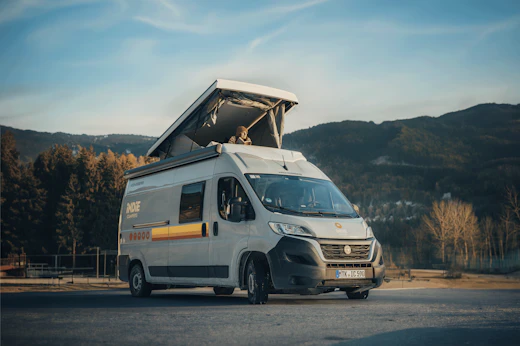
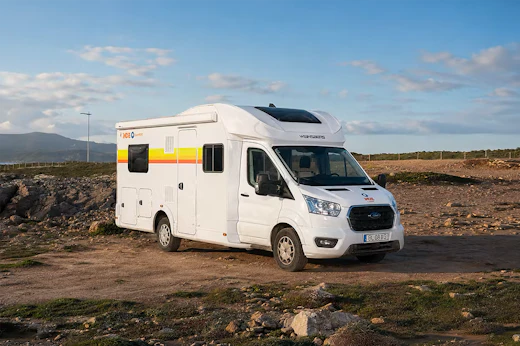
The sleeping capacity of our campervans and motorhomes varies depending on the model and size. Our Class C motorhomes can typically accommodate 4 to 8 people, while our Class B campervans can sleep between 2 to 4 people. Vehicles equipped with a rooftop tent generally have space for around 2 people. For a full breakdown of our models and sleeping capacities, click here.
If you're exploring Berlin in a campervan rental, it's essential to be aware of the country’s official camping regulations. Many natural areas are legally protected, so using designated overnight parking spots or official campsites is strongly recommended. This not only helps preserve the environment but also ensures a safe and enjoyable experience. For more guidance on safety and responsible camping, click here.
We provide three different protection plans to cover any incidents or damages that might occur during your campervan rental. All Indie Campers campervans come with third-party vehicle insurance, and property damage coverage (which varies based on the country). For marketplace rentals, insurance options may differ depending on the host. For further details on campervan insurance, visit this page.
Yes, our search filter makes it easy to rent a campervan close to your location by using a 60km radius system. Depending on where you're searching from, you can quickly find the nearest Indie Campers campervan rental pick-up centre.
Yes, a selected number of Indie Campers RV rentals in Berlin include unlimited mileage, allowing you to explore freely and make the most of your road trip! Please note that unlimited mileage applies exclusively to Indie Campers RVs and is subject to responsible use.
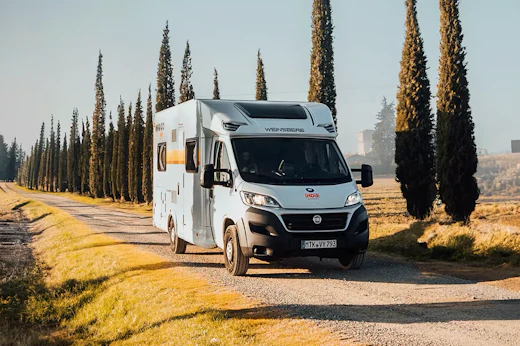
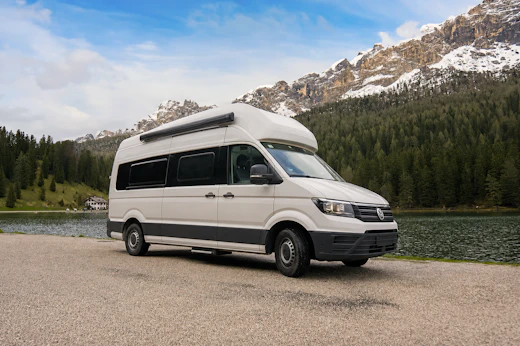
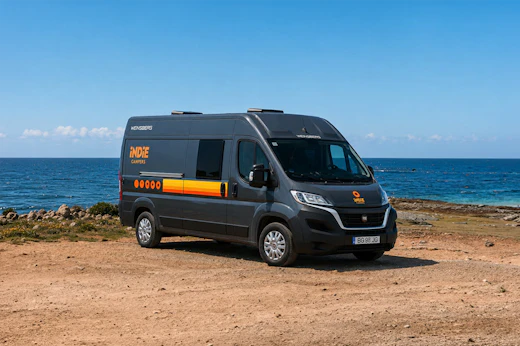
Our Campervans






“Amazing service and amazing experience ”
“We had a great time with the Fiat Nomad for two months while traveling from Berlin to Scandinavia. We had a wonderful trip. The Nomad kept us cozy and warm during late fall. The team at Indie Berlin was super helpful. We also stopped by Indie Campers Oslo and they gave us recommendations for snow chains, propane refills and refilled our water. It was the perfect way to travel through Scandinavia! ”
“It was such a nice experience with our friends and family. I would recommend Indir Campers to anyone interested in experiencing freedom and functionality”
Our Road Trips Itineraries