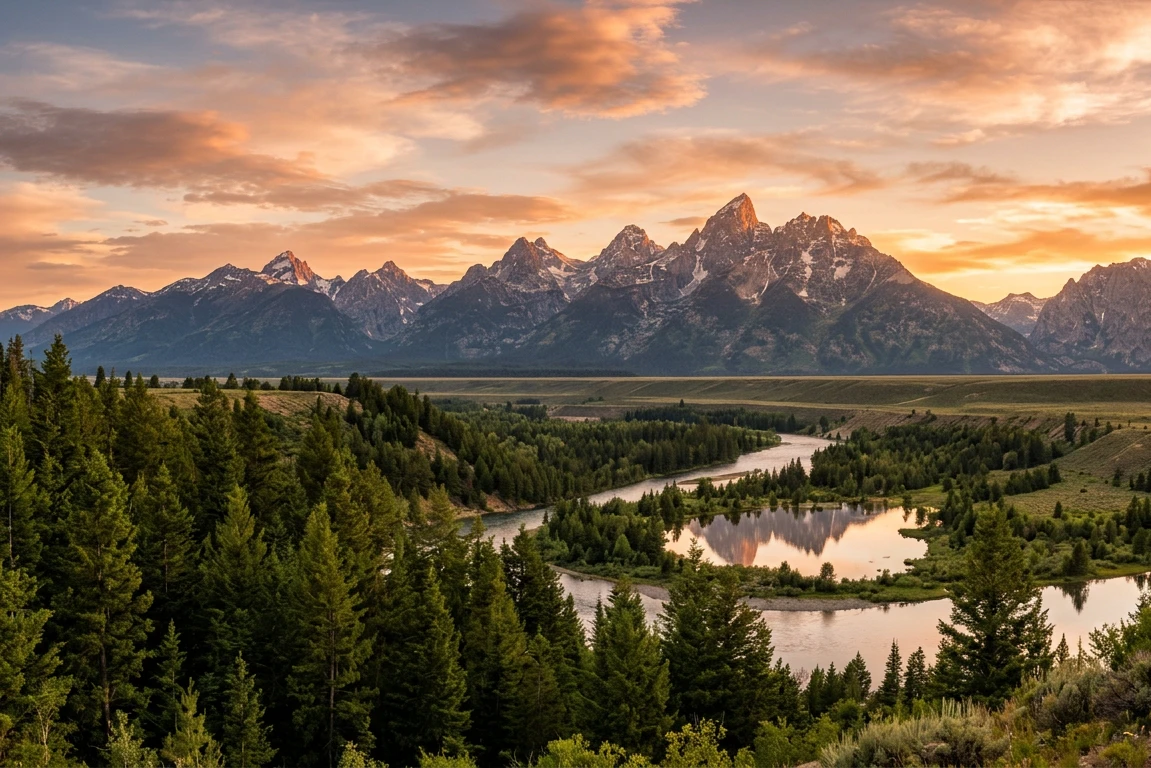
The Teton Range rises abruptly 7,000 ft above Jackson Hole with no foothills, mirrored in Jenny and Jackson Lakes and the Snake River. Colter Bay RV Park offers full hookups; Gros Ventre is the large no-hookup option. Indie Campers’ Salt Lake City depot is about five hours / 290 miles south, and Grand Teton connects directly to Yellowstone just to the north.

Getting the right vehicle is half the battle. The roads inside Grand Teton are generally wide and well-maintained, but some, like the Moose-Wilson Road, have strict length restrictions. Our fleet is built for this. You get comfort and utility without piloting a 40-foot land yacht that can't fit into the scenic pullouts.
The drive from our Salt Lake City depot is an easy first day. Just 290 miles. About five hours up I-15 and US-89. Every rental comes with unlimited mileage, so you can explore every side road and detour without watching the odometer. And our 24/7 roadside assistance means you’re never truly on your own. For Grand Teton, we recommend our Standard or Family models; they're nimble enough for park roads but spacious enough for a week of adventure.
Teton Park Road (The Main Corridor)
This 42-mile scenic drive is the heart of the park. It connects Moose to Jackson Lake Junction, paralleling the base of the Teton Range for nonstop, iconic views. Key stops include the Taggart Lake Trailhead, Jenny Lake Scenic Drive, and the Signal Mountain summit road. Plan for a full day to do it justice. RVs can easily navigate this road, and the pullouts are numerous and large. The real challenge is finding a parking spot at popular areas like Jenny Lake or String Lake after 10 a.m. in July and August. Go early. Seriously. The road is typically closed to all traffic from Taggart Lake to Signal Mountain Lodge from November 1 to April 30.
Jenny Lake Scenic Drive
A short, three-mile, one-way loop that branches off Teton Park Road, this drive gets you closer to the Cathedral Group: Grand Teton, Mount Owen, and Teewinot. It offers access to the Jenny Lake boat dock and numerous trailheads. It's a slow-going road, so RVs need to take it easy. Parking is extremely limited. If you have a larger rig, consider parking at the main Jenny Lake Visitor Center and walking or biking the multi-use path to access the scenic drive and its views. The road is often closed to vehicles over 23 feet, so check with the National Park Service for current conditions.
US Highway 191/89/26 (The Eastern Route)
This highway runs along the eastern boundary of the park through Jackson Hole, offering a panoramic, wide-angle perspective of the entire Teton Range. This is where you'll find the most famous viewpoints for photography. Key pullouts, from south to north, are Blacktail Ponds Overlook, Schwabacher Landing (a short, bumpy dirt road, take it slow), Snake River Overlook (Ansel Adams's famous spot), and Oxbow Bend Turnout. This route is a major highway and easily navigable for any size RV. It's also your main access to the towns of Moose and Moran.
Overnighting in a parking lot or pullout is strictly illegal inside the park. You must be in a designated campsite. Reservations are essential and can be made up to six months in advance on Recreation.gov. They sell out for peak season dates. Fast. We're talking minutes.


Summer (June to August): This is peak season for a reason. All roads, trails, and facilities are open. The weather is generally warm and sunny, and wildflowers carpet the meadows in July. The downside? Crowds. Campgrounds are full, parking lots are packed by mid-morning, and you'll share the trails. If you visit in summer, your strategy should be to get up and out before 8 a.m. to beat the rush.
Fall (September to October): Many locals consider September the best month. The crowds thin out, the aspens turn a brilliant gold, and the crisp air is perfect for hiking. The park's elk are in their rut, and you can hear their bugling echo through the valleys. Services start to close in late September and October, and the first snows can dust the high peaks.
Winter (November to March): Grand Teton becomes a quiet, snow-covered wonderland. Teton Park Road is closed to vehicles but groomed for cross-country skiing and snowshoeing. Wildlife is concentrated in the lower valley. It's a magical time, but an RV trip is challenging. Only Headwaters at Flagg Ranch offers winter camping, and you'll need a winter-ready rig.
Spring (April to May): This is the season of mud and slush, but also of rebirth. Bears emerge from hibernation, and bison calves are born. The valley floor melts out, but many roads and most trails remain snow-covered until late May or even June. It's a quiet time to visit, but access is limited, and many campgrounds don't open until Memorial Day weekend.
Booking a spot in Grand Teton requires planning. Serious planning. All reservable campsites are managed through Recreation.gov and are released on a 6-month rolling basis. For a July 15th booking, you need to be online at 8 a.m. Mountain Time on January 15th. They will be gone in under five minutes. No, that's not an exaggeration. Set an alarm.
Yes. Indie Campers’ Salt Lake City depot is about 5 hours (290 miles) south — the standard approach — and the drive itself is scenic. Grand Teton pairs with Yellowstone, so many travelers do both in one loop.
Yes — Colter Bay RV Park on Jackson Lake has full hookups and books out early. Gros Ventre, Signal Mountain and Colter Bay tent-and-RV loops take RVs without hookups.
Moose-Wilson Road
This is the one to be careful with. The 8-mile road between Moose and Teton Village is narrow, winding, and partially unpaved. It’s famous for wildlife, especially moose and bears. For that reason, it has a strict vehicle length limit: nothing over 23 feet 9 inches (7.2 meters). Our Compact and some Standard models fit; larger RVs and trailers are prohibited. If your vehicle is too large, you can still access the southern end from Teton Village, but you won't be able to drive the full length. It's a beautiful drive, but respect the rules. They're there for a reason.
Dump Stations and Water: Dump stations with potable water are available at Gros Ventre, Signal Mountain, and Colter Bay Campgrounds for a small fee if you are not a registered camper. Headwaters also has a dump station. Outside the park, the Jackson Hole Chamber of Commerce has a free public dump station, and many private RV parks in Jackson offer the service for a fee.
June through September. Higher campgrounds and services open late May–June and close by October; winter closes most roads and facilities.