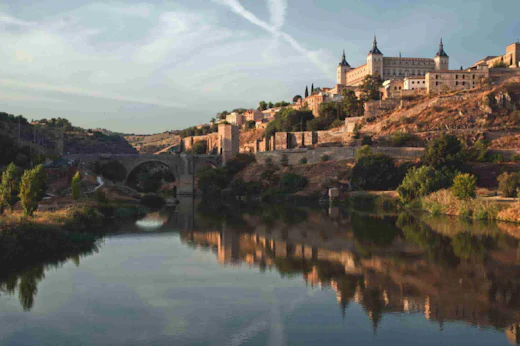
Toledo's known as the City of the Three Cultures because, for many years, Christians, Jews and Muslims lived together peacefully in its narrow, hilly streets. The old city sits on a hilltop surrounded on three sides by a bend in the River Tagus. As your campervan approaches the city, the view from a distance is unforgettable.
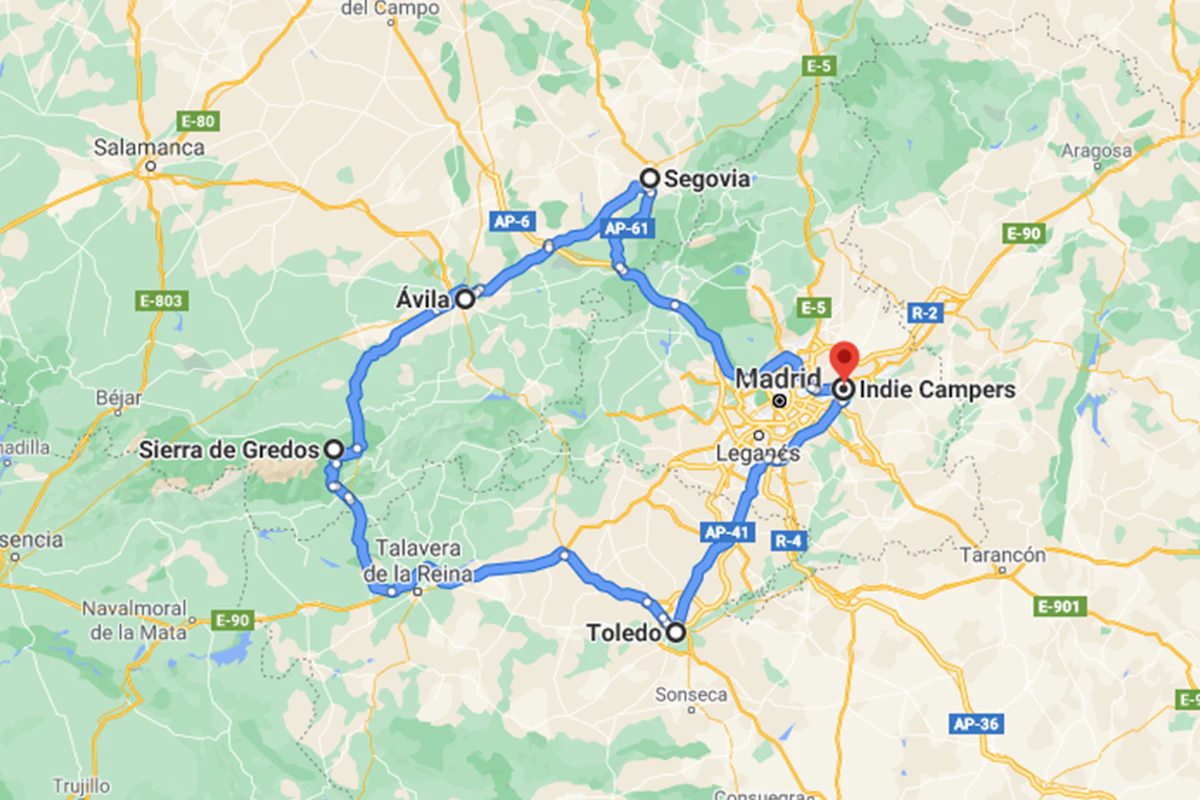
An hour's drive from Madrid, make Toledo the first stop on your road trip through central Spain. A UNESCO World Heritage Site since 1987, the city is packed with medieval churches, synagogues and mosques that are well worth a visit.
The old city walls and gates still stand, as do two stunning bridges over the river: the Roman Alcántara Bridge and the San Martín Bridge.

Surprisingly, Spain is, after Switzerland, Europe's most mountainous country. Many people only think of Spain for beach holidays, despite it offering a wide range of stunning natural landscapes.
Sierra de Gredos, still unknown to many Spaniards, is a gorgeous mountain range west of Madrid and home to the Iberian Ibex, the Spanish wild goat.
As you leave Toledo on your central Spain road trip, drive towards Talavera de la Reina and from there to Arenas de San Pedro, a perfect spot to rest or grab lunch. One of the main attractions of Sierra de Gredos is the walk to its glacial lake, Laguna de Gredos. From the Plataforma Gredos car park, it's about a two-hour walk to the lake.
The path is well signposted and fairly gentle, though stony at times. It's common to spot wild goats from the path, especially outside the peak season.
There are many paths to explore in the Sierra de Gredos. For experienced, fit walkers, one of the most beautiful is the route to Cinco Lagunas (Five Lakes). The out-and-back walk is 25 km, so set off very early if you want to complete it in one day, or camp overnight by one of the lakes.
Another of Spain’s many UNESCO World Heritage sites, Ávila is famous for the walls that surround the old city. Started in 1090, the walls have a perimeter of 2,516 metres (~8,255 feet), an average height of 12 m (~42 feet), and a total of 9 gates.
It’s possible to walk along the walls themselves for half their circumference. It’s also said that the walls are the largest fully illuminated monument in the world — so why not try a night-time walk along the walls?
Don’t just admire them from outside the city — venture inside them and wander around this small, charming city full of history. An impressive collection of old churches, monasteries and museums will transport you back to medieval Castile.
And while all are worth a visit, pick the main cathedral and the Monastery of St Thomas if you’re sticking to the Central Spain road-trip itinerary and only staying for the day. If you do, leave Ávila at night to head for your final destination, Segovia.
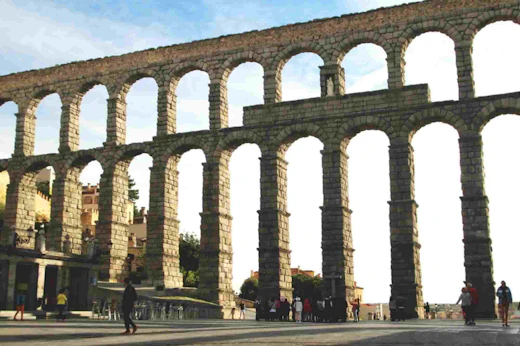
Segovia’s main symbol is its Roman aqueduct, still used today to deliver drinking water to the city. Due to its length, beauty and location, it’s considered the most impressive Roman structure in all of Spain.
Built with 25,000 granite blocks held together without any mortar, it spans 818 metres (≈2,684 feet). With more than 170 arches, the tallest reaching 29 metres (≈95 feet), the aqueduct is an imposing engineering wonder.
Besides the aqueduct, Segovia is also well known for the Alcazar, the Royal Palace that Walt Disney used as inspiration for Cinderella’s Castle, and its stunning Gothic cathedral. Don't miss trying Segovia’s signature dish, roasted suckling pig — the perfect last meal on your Central Spain road trip.
And if you’re still up for more exploring before driving your campervan back to Madrid, it’s worth heading to Pedraza, a well-preserved medieval village often hailed as one of the most beautiful in Spain.