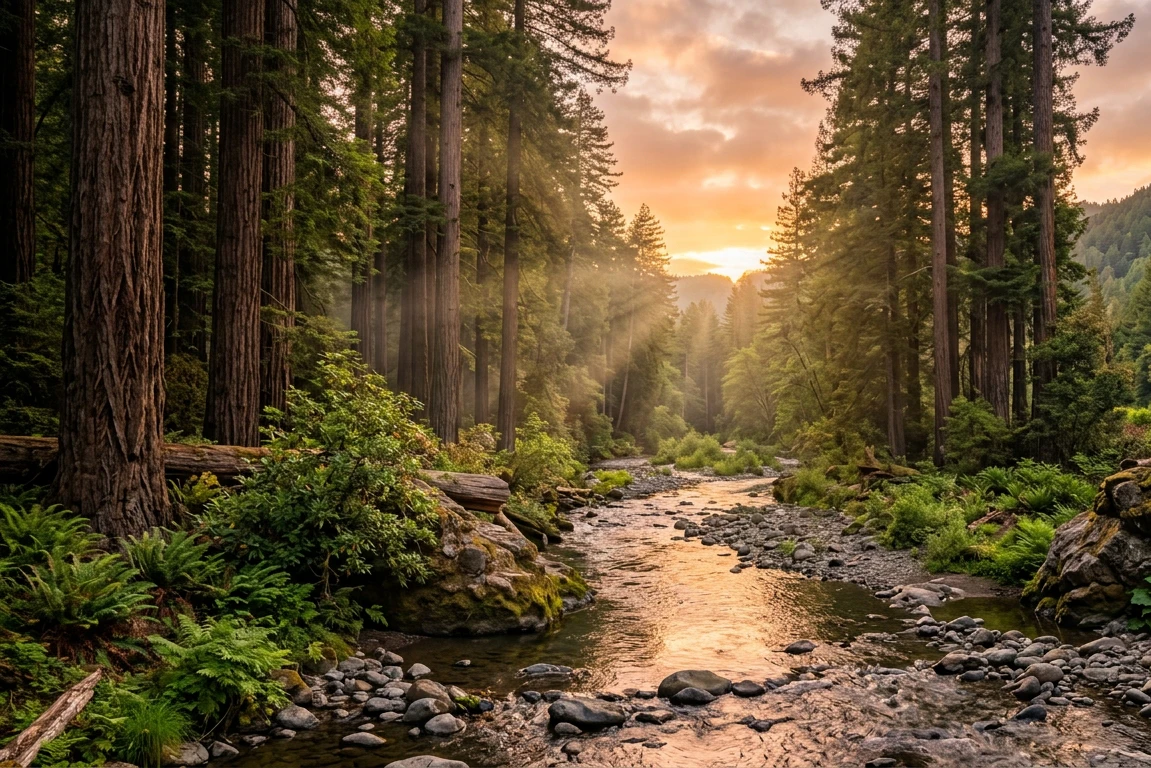
Redwood protects the tallest trees on earth along a foggy stretch of northern California coast, combining old-growth groves with wild beaches and Roosevelt elk meadows. Campgrounds such as Jedediah Smith, Elk Prairie and Mill Creek sit among the redwoods (no hookups). Indie Campers’ San Francisco depot is about five to six hours / 320 miles south on Highway 101.
Redwood's roads are narrow. And winding. A 40-foot Class A motorhome is simply too large for them, and the campgrounds are just as rustic. Choosing the right vehicle is the single most important decision you'll make. Our team has seen people try to force a big rig down a road clearly marked "No Vehicles Over 24 Feet." It doesn't end well.
Our fleet is specified for this kind of travel. You get unlimited kilometres. That's critical for the 600-plus-mile round trip from the Bay Area. You also get 24/7 support, which is reassuring when cell service is patchy. Our San Francisco depot is the logical starting point, a 320-mile, 5-to-6-hour drive south of the park that lets you pick up your van, provision in the city, and be on Highway 101 heading north by lunchtime.
For Redwood, we recommend our Standard or Compact class vans. They are nimble enough for scenic drives like the Newton B. Drury Parkway and fit comfortably into the sites at Jedediah Smith or Elk Prairie campgrounds.
Navigating the park's roads in a campervan is straightforward, as long as you stick to the main arteries. The problems start when you don't. Some of the most famous groves are on unpaved roads with strict length and width restrictions. Know before you go.
Newton B. Drury Scenic Parkway This 10-mile paved road runs parallel to Highway 101. It cuts right through the heart of Prairie Creek Redwoods State Park. The road is smooth and wide enough for any of our campervans, with numerous pull-outs for trailheads like the Big Tree Wayside. It's the best way to feel immersed in the forest without leaving your vehicle. Give yourself at least 45 minutes. Drive it slowly.
Enderts Beach Road Find this short, paved drive south of Crescent City. It leads to a coastal overlook and a trailhead for a secluded beach. The road is fine for campervans. The parking lot at the end has enough room to turn around. It's a great spot for a sunset picnic.
Coastal Drive Loop This 8-mile loop off Highway 101 offers dramatic ocean views. The southern portion is paved. But the northern section becomes a narrow, one-way gravel road that is not recommended for campervans. A better plan? Drive the paved southern section to the High Bluff Overlook. Then just turn around.
* campervan-restricted roads to avoid:**
Howland Hill Road: A gravel road through Stout Grove, but it's narrow, winding, and strictly prohibits campervans and trailers.
This is the most important rule of the park. Pay attention. You can only camp overnight in designated campgrounds. Sleeping in your vehicle in a parking lot, pull-out, or at a trailhead is strictly prohibited, and yes, fines are enforced. While dispersed camping is available on nearby National Forest or BLM land, it is not allowed within the park boundaries themselves.
All four developed campgrounds in the park system are managed by the California State Parks and require reservations, which you should make months in advance on ReserveCalifornia.com for the summer season. None of them have hookups (water, electricity, sewer). Plan on dry camping. A dump station is available at Jedediah Smith campground.


While the main roads are open year-round, the experience changes dramatically with the seasons. The key variable isn't snow. It's rain and fog.
Spring (March to May): Temperatures are cool (40-60°F) and rain is frequent, but the forests are lush, vibrant with new growth and wildflowers. Crowds are thinner. You might find more last-minute availability in campgrounds, making it a great time for photographers who love moody, misty scenes.
Summer (June to August): This is peak season. Expect dry, mild weather (50-70°F). But also expect thick coastal fog, especially in the mornings. Campgrounds will be fully booked. Popular trails will be busy. The long days give you plenty of time to explore, but you need to plan and book everything far in advance.
Fall (September to October): Fall is often the best time to visit. The summer crowds have dispersed. The weather is often the sunniest and warmest of the year. The fog is less persistent. In the understory, maples add a touch of autumn color to the evergreen forest.
Booking a campsite is critical. It's the most important part of your trip planning. Seriously. Don't just show up in July without a reservation, because that's a recipe for disappointment. Here’s the breakdown.
Yes. Indie Campers’ San Francisco depot is about 5–6 hours (320 miles) south — the drive up Highway 101 through the Avenue of the Giants is part of the trip.
The Newton B. Drury Scenic Parkway is paved and campervan-friendly. Some old-growth spur roads (Howland Hill, Cal-Barrel) are narrow gravel and ban or discourage campervans and trailers — use the main parkway and park to walk the groves.
Jedediah Smith, Mill Creek, Elk Prairie (Prairie Creek) and Gold Bluffs Beach take campervans without hookups, though several have length limits around 24–36 ft. Reserve ahead in summer.
Late spring through early fall for the driest weather, though coastal fog is common year-round — that fog is exactly what the redwoods depend on. Roads stay open all year.