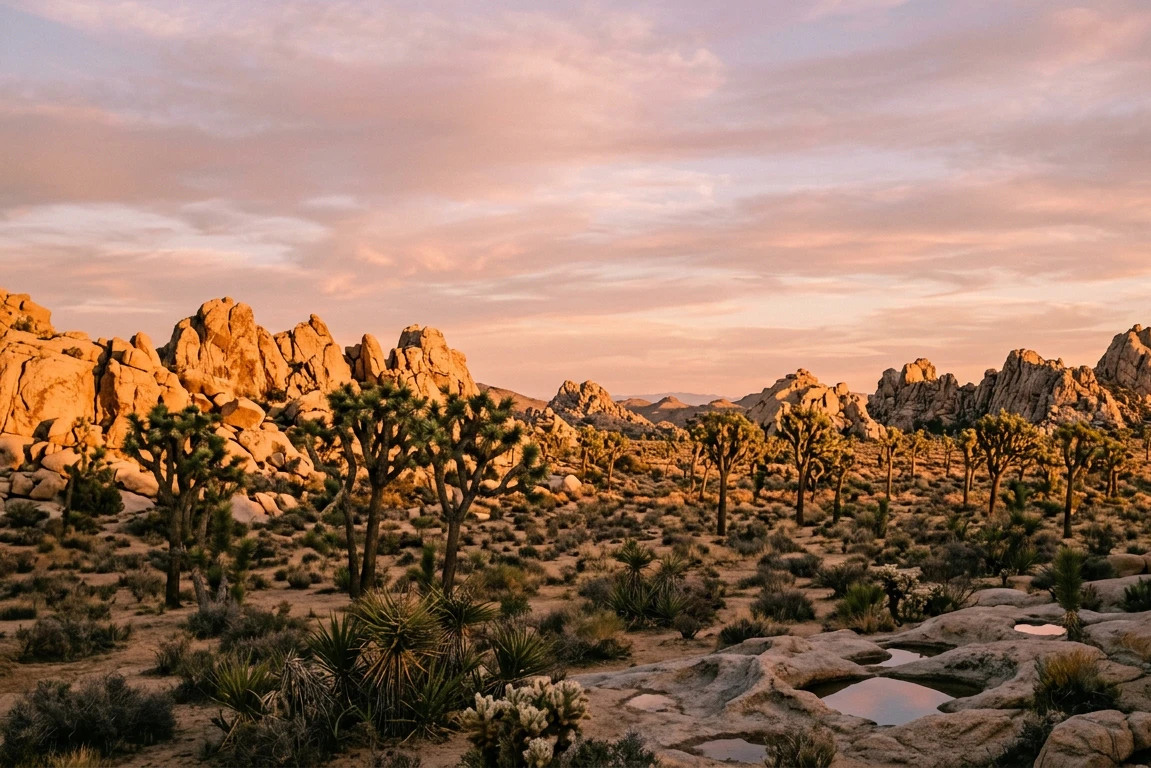
Joshua Tree National Park spans two deserts, the Mojave and the Colorado, and a campervan lets you camp inside the park and reach trailheads before sunrise. There are no hookups anywhere in the park; Black Rock and Cottonwood Spring have water and a dump station. Indie Campers depots in Los Angeles and Las Vegas are both under a four-hour drive.
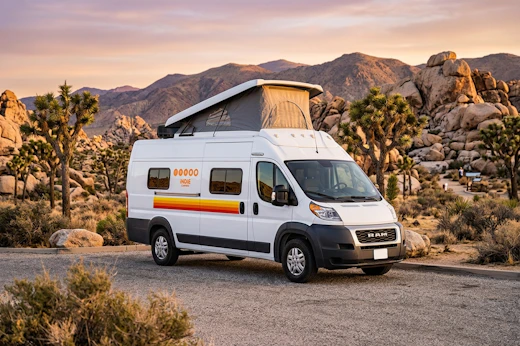
Indie Campers has vehicles suited to a Joshua Tree trip, from compact vans that are easier to park at busy trailheads like Hidden Valley and Barker Dam, to larger motorhomes if you're combining the park with a longer road trip. Every hire comes with unlimited kilometres and 24/7 support, which matters here given how little cell service there is once you're off the main roads.
Flexible booking and free cancellation also make sense for a desert trip, since the difference between a comfortable spring visit and a brutal summer one often comes down to a short shift in dates, and it helps to be able to adjust without losing your deposit. If you're planning to hit more than one national park on the same trip, the America the Beautiful annual pass is worth the $80, since it pays for itself after three park entries and covers everyone in the vehicle.
We recommend picking up the campervan at least a day before you plan to enter the park, so you can load water and groceries in Los Angeles, Las Vegas, or one of the gateway towns rather than arriving with an empty tank.
campervan size tip: for Joshua Tree specifically, a campervan under 7.62 m is easiest to manage at the smaller day-use parking areas near Hidden Valley and Barker Dam, which fill early on weekends. Larger rigs are fine on the main through-roads and at Black Rock or Cottonwood.
The nearest Indie Campers depots are Los Angeles, about 225 km and under three hours from the West Entrance via I-10 E, and Las Vegas, about 306 km and roughly three hours via I-15 S and CA-62. Both make sense as a starting point depending on which coast you're flying into.
Park Boulevard (West Entrance to Jumbo Rocks)
Key stops: Hidden Valley, Skull Rock, Jumbo Rocks Approx drive time: 30 to 45 minutes without stops, a half day with viewpoints Best time to go: morning, before the Hidden Valley and Barker Dam car parks fill campervan notes: the road itself is a well-maintained two-lane paved route, but the pull-offs at Hidden Valley and Barker Dam are small and fill by mid-morning in peak season
Pinto Basin Road (Cholla Cactus Garden to Cottonwood)
Key stops: Cholla Cactus Garden, Ocotillo Patch, Cottonwood Spring Approx drive time: 45 minutes to an hour without stops Best time to go: late afternoon, when the low light catches the cholla spines campervan notes: long, straight, and quiet compared to Park Boulevard, with the fewest services of any route in the park, so top up water and fuel before you start
Keys View Road
Key stops: Keys View overlook Approx drive time: 20 minutes each way from the Park Boulevard junction Best time to go: sunset, for the view over the Coachella Valley toward the Salton Sea campervan notes: paved and winding but manageable in any Indie Campers vehicle; the car park is compact, so a weekday visit avoids the worst of the crowding
Geology Tour Road
Key stops: Wonderland of Rocks overlooks, historic mining sites Approx drive time: 2 to 3 hours return trip if you drive the full 29 km Best time to go: cooler months only, since there's no shade for most of the route campervan notes: unpaved and better suited to a shorter rig or a tow vehicle rather than a large motorhome; check current conditions at a visitor centre before setting out, since washboarding can be significant after rain
Jumbo Rocks: the largest campground in the park, set among the boulder formations near the centre of Park Boulevard. Dry camping only, no hookups. Reservations required most of the year; some sites first-come, first-served in summer.
Black Rock: in the northwest corner of the park, near Yucca Valley. One of only two campgrounds with potable water and a dump station. Reservations essential, especially in spring.
Cottonwood Spring: in the southern, Colorado Desert section near the I-10 entrance. The other campground with water and a dump station, and the natural stop if you're arriving from the south or east.
Hidden Valley and Belle: smaller, first-come first-served campgrounds without water or a dump station, better suited to shorter rigs given the tighter site spacing. Both fill early on weekends between October and May, so arriving by mid-morning is the safest bet if you're not booking a site elsewhere in advance.


Spring (March to May): the most popular season, with mild days, cool nights, and wildflowers in good years. Campgrounds book out months ahead for this window.
Summer (June to August): genuinely hot, often over 38 °C by midday. Workable with an early start and a midday break in the campervan, but not the season for a first visit.
Autumn (September to November): similar advantages to spring, mild days and cooler nights, with noticeably smaller crowds.
Winter (December to February): cool days, often into the 60s°F (mid-teens°C), with nights that can drop below freezing. Quiet, clear, and the easiest season for finding a first-come site.
Jumbo Rocks: no hookups, first-come sites available in summer only, reservations required the rest of the year through Recreation.gov, typically released six months ahead and going quickly for weekends. Best for: central access to Park Boulevard's sights, and the easiest campground to reach an early start from for Ryan Mountain or Skull Rock.
Black Rock: no hookups but has potable water and a dump station, reservations required year-round, books out fastest in spring. Best for: travellers who want to refill water partway through the trip without leaving the park.
Cottonwood Spring: no hookups, water and dump station on site, reservations required, generally easier to book than Black Rock or Jumbo Rocks. Best for: arrivals from the south via I-10.
Hidden Valley and Belle: no hookups, no water, first-come first-served only. Best for: smaller rigs and travellers happy to arrive early to secure a site.
Waste disposal points: Black Rock and Cottonwood Spring both have dump stations inside the park; there are no others within the boundary. Outside the park, Twentynine Palms and Yucca Valley both have campervan service stations, and it's worth planning to empty tanks on the way in or out rather than relying on finding a same-day slot during a busy weekend.
Yes. Indie Campers has depots in Los Angeles and Las Vegas, both under a four-hour drive from the park’s entrances.
No campground in the park has electric or sewer hookups. Black Rock and Cottonwood Spring both have potable water and a dump station; every other site is fully dry camping.
Compact to mid-size campervans, generally under 7.62 m, are easiest to manage at the smaller day-use parking areas like Hidden Valley and Barker Dam. Larger rigs work fine on the main roads and at Black Rock or Cottonwood.
Reservations for Jumbo Rocks, Black Rock, and Cottonwood Spring open on Recreation.gov roughly six months ahead and go quickly for spring and autumn weekends. Hidden Valley and Belle are first-come, first-served only.
Black Rock and Cottonwood Spring both have dump stations inside the park. Twentynine Palms and Yucca Valley have services just outside it.
Spring and autumn offer the mildest weather and are the most popular; summer is very hot and better suited to an early-start itinerary; winter is quiet with a real chance of a cold night.
Park Boulevard covers the main Mojave-side sights, Pinto Basin Road runs south through the Colorado Desert to the Cholla Cactus Garden, and the short Keys View Road spur is worth the detour for the overlook alone.
No. Overnight stays are only permitted in designated campgrounds; overnight parking at trailheads or viewpoints is not allowed.
Coverage is patchy to nonexistent away from the main entrances. Download offline maps and tell someone your route before you head in.