Capitol Reef follows the Waterpocket Fold, a 161 km wrinkle in the earth, and centres on the historic Fruita orchards along the Fremont River. Fruita Campground has 71 shaded sites (no hookups) beside the orchards. Indie Campers’ Salt Lake City depot is about 3.5 hours / 354 km northwest, with Highway 24 running right through the park.
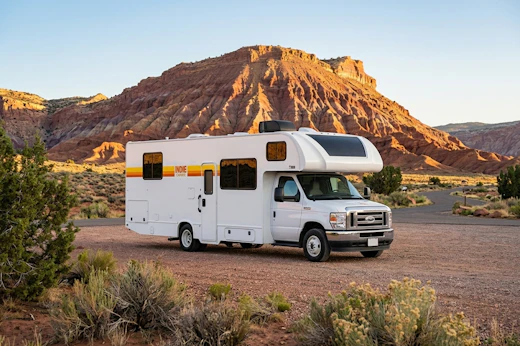
The right vehicle makes a Capitol Reef trip smoother. While the park’s main roads are well-maintained, a nimble campervan handles the campground loops and viewpoint pull-outs much better than a large campervan. Our depot team knows what works.
Our Salt Lake City depot is the best starting point. It's a 354 km (3.5-hour) drive from the park's west entrance. Pick up your van. Provision at a supermarket. You can be setting up camp in Fruita by late afternoon. For a more ambitious itinerary, a one-way trip from our Las Vegas depot creates a grand circle through all of Utah's national parks.
Unlimited kilometres is included with all our hire. That's essential for a state where distances are vast. Focus on the scenery. Not the odometer. And with 24/7 support, if you have a question about the fridge at 10 p.m. in a remote campsite, we’re there to help.
For Capitol Reef, we recommend our Standard or Family size vans. They are compact enough to navigate the Fruita Campground loops and fit into standard parking spots at trailheads, something larger campervans struggle with.
Driving is how you see Capitol Reef's immense scale. While some spur roads are unpaved and treacherous, the main routes are perfect for a campervan. Just be smart. Always check road conditions at the visitor centre, especially after rain.
Capitol Reef Scenic Drive
This is the park's main paved road, running 12.9 km south from the visitor centre into the heart of the park's geology. The road is well-maintained and suitable for any campervan. The drive itself takes about 90 minutes return trip, but budget at least half a day to stop at overlooks and explore the two unpaved spur roads: Grand Wash and Capitol Gorge. These spurs are usually passable for smaller campervans in dry weather, but they can be sandy and rough. Never enter if there's a chance of flash floods.
Utah State Route 24
Utah's Highway 24 is a road through Capitol Reef. Not just a road to it. This state highway cuts west-to-east for 25.7 km, crossing the most dramatic section of the Waterpocket Fold. Key stops directly on the highway include the Petroglyph Panel, Behunin Cabin, the Fruita Schoolhouse, and the overlooks at Panorama Point and Goosenecks, and the road is fully paved and suitable for any size campervan.
Notom-Bullfrog Road and the Burr Trail Loop
This 200 km loop is a serious commitment. It's for confident drivers in smaller, high-clearance campervans only. The route follows the eastern side of the Waterpocket Fold on the mostly unpaved Notom-Bullfrog Road before climbing the Burr Trail switchbacks back to the town of Boulder. It's a full-day drive. The roads can be impassable when wet. Check with rangers at the visitor centre before you even think about attempting it.
This is the most important piece of your trip planning. Capitol Reef has very limited developed camping, and it books up fast. You need a strategy.
Image placeholder


Timing is everything in the desert. Capitol Reef's best seasons are spring and autumn, but each has its own character.
Spring (March to May): This is prime time. Temperatures are pleasant, ranging from the 50s to the 70s Celsius. The orchards burst into blossom in April, creating a surreal landscape of pink and white flowers against red rock. It’s popular, so campground reservations are essential.
Summer (June to August): It gets hot. Daytime temperatures frequently push past 32.2 °C, making midday hiking difficult. This is also monsoon season, which brings the risk of flash floods that can close the park's unpaved roads with no warning. But there's an upside. The orchards are full of ripe apricots and peaches, and the crowds are slightly thinner than in spring.
Autumn (September to October): Another perfect season. The summer heat breaks. The crisp autumn air is ideal for hiking. The main apple and pear harvest happens in September, and the cottonwood trees along the Fremont River turn a brilliant yellow, adding another layer of colour to the canyons.
Winter (November to February): The park is quiet. And beautiful. It's often dusted with snow. Most services are closed, and temperatures are cold, often dropping below freezing at night. Campervan camping is possible for the well-prepared, but you'll need a winterised rig and a solid plan for dealing with freezing temperatures.
Getting the details right for a campervan trip to Capitol Reef is straightforward. Just plan ahead. The biggest hurdle is securing a spot at Fruita Campground.
Booking Your Campsite
The Fruita Campground is the only developed campground in the park and is operated by the National Park Service. You book it through Recreation.gov.
Managing Campervan Resources
Yes. Indie Campers’ Salt Lake City depot is about 3.5 hours (354 km) away. Capitol Reef sits in the middle of Utah’s "Mighty 5," so it slots neatly into a one-way loop with Bryce, Zion, Arches and Canyonlands.
The paved 12.9 km Scenic Drive is fine for campervans; its spur roads (Grand Wash, Capitol Gorge) are graded dirt and can be rough — check conditions and avoid them after rain. Highway 24 through the park is a normal campervan-friendly state route.
> A quick word on wild camping: Overnight parking in overlooks, pull-outs, or trailheads inside Capitol Reef National Park is strictly prohibited. Don't do it. You will be ticketed. Camping is only allowed in designated campgrounds or with a permit for the backcountry.
Fruita Campground takes campervans up to about 15.8 m (no hookups) among the orchards — you can pick fruit in season. There is a dump station and water. It books out in spring and autumn, so reserve early.
April–June and September–October, when the orchards are in blossom or fruit and temperatures are mild. Summer is hot and flash floods can close the dirt spur roads.